Nissan Heritage
Since 1933, Nissan has been creating the kinds of cars that move people's hearts. In our pursuit of this ideal, we have always challenged the limits of what is possible by rejecting assumptions and turning conventional wisdom on its head. Our history has seen us take on an endless series of challenges. Looking back over those years, one can see that the challenges we have taken on have centered on four main areas.
Sustainability
We have never lost sight of the importance of our relationship with society and have always remained focused on the effects we have on people's lives. Thanks to this approach, the innovations that we have made along the way have sometimes transcended the realm of auto manufacturing and have brought about wide-ranging societal changes. For example: zero emission vehicles. Nissan's development of electric vehicles began with the Tama electric car. That work led to today's Nissan LEAF and e-NV200 EVs.
Accessibility
Ever since Nissan's founding, we have placed importance on bringing the fun and convenience of automobiles to all. With Datsun brand cars, we aimed to enable each household to own their car by creating Japan's first mass-produced automobile, and these cars are now symbolic of that age. With the Nissan Z-car series we also made owning a sports car something everyone could achieve.
Diversity
Learning from engineers from overseas, collaborating with companies with differing areas of strength, and increasing Nissan's organizational and cultural diversity have all contributed greatly to our auto manufacturing capabilities. More than 80 years have passed since our founding, a time when we were striving hard to learn from the cutting-edge technologies of companies outside Japan as quickly as we could. Today, we have R&D bases located around the globe and are therefore able to reflect the culture and preferences of local people in the cars we create.
Passion
We are passionate about driving, not only with cars like the Skyline and GT‑R, but with all of the cars we produce. This passion grows more intense with the passing of time. Through our long years of experience in motorsports, we have learned a great deal about making cars that are faster, more beautiful, safer, more responsive, and simply more fun to drive. Our passion is to create better cars for our customers. We will continue to refuse to be beholden to conventional wisdom. We are driven by the goal of moving people, moving their hearts, and changing history; we will never cease in these efforts.
Nissan has been a pioneer in creating and developing electric vehicles (EV). With 70 years of EV heritage, built on the legacy of Prince Motors, Nissan's goal is to bring the benefits of EV to more people in more places.
"Nissan Legends"
Life and Times of Mr. K, Yutaka Katayama, Part 1
Life and Times of Mr. K, Yutaka Katayama, Part 2
We are, and will continue to be, among the "Nissan people" who have impact on the lives of our customers, continuing a proud tradition established and maintained for more than 80 years.
As a result of our employees' efforts and innovations, Nissan has able to shape its history for 80 years while overcoming countless difficulties and with many great achievements. In "Nissan Legends," we highlight some past and present employees who have contributed to the success of Nissan and who symbolize the soul of Nissan.
Writers from one of Japan's leading car magazine, Car Graphic, took a deep dive into the lives of these people to shed light on Nissan's roots based on their extensive interviews and insights in the auto industry. (All info in the "Nissan Legends" is accurate as of 2013 when it was written.)
Nissan Heritage in Photos, Videos and Catalogs
Nissan Heritage Gallery contains photos, videos and catalogs filled with Nissan history. The content in this section is organized by content type (photo, video, catalog), period (1930s to 2000s), car model, and other topics. Below are two looks at Nissan's past:
DATSUN Manufacturing process (1935)
DATSUN Bluebird 310 New Model Premiere (1959)
Nissan Heritage Stories
Since Nissan was founded, we have given our all to manufacture the best automobiles. Through the years, Nissan has strived to inspire people, move hearts and enrich lives. We question assumptions, upset conventional wisdom and attempt the impossible. Looking back on this manufacturing excellence that continues today, there are many stories. "Nissan Stories" shares some of these episodes, as we look back at the history – and future of – the automobile.
Read more "Nissan Stories" here.
Nissan Heritage Collection at Zama
The Nissan Heritage Collection contains hundreds of heritage vehicles stored at Zama Heritage Car Garage in Japan. Here, we preserve the representative vehicles in our long history – innovative, epic and victorious cars that are our priceless assets and living archives.
Nissan Heritage Collection at Zama Image Gallery
Nissan Heritage Collection Virtual Museum: 1920s to 2000s
Datsun's roots go all the way back to 1914 when the Kwaishinsha Co. manufactured their first car, the DAT (D, A, and T being the initials of the three investors). It was followed by a smaller car that was to be christened DATSON (son of DAT), but because of the inauspicious associations of "son" (sounds like the Japanese word for "loss"), this was changed to DATSUN when the vehicle went on sale in 1932.
Visit the Nissan Heritage Collection here.
Visit the Nissan Heritage Collection (Japanese) here.
Nissan Heritage Production Models
Electric Vehicles
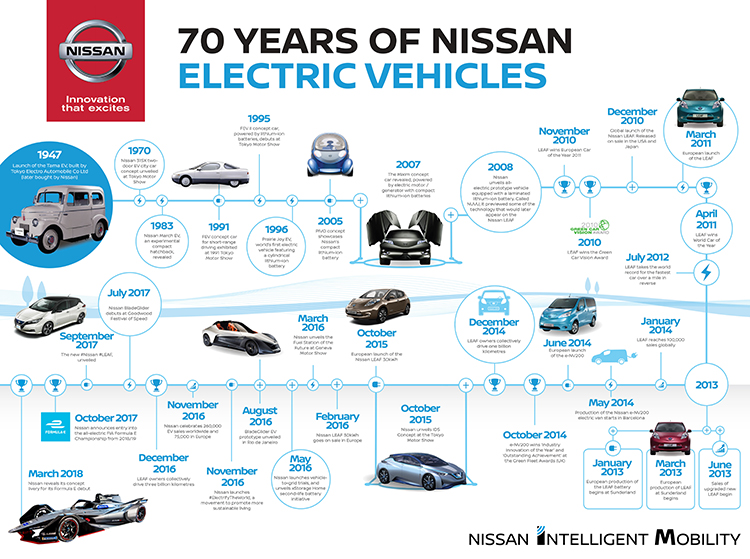
Nissan released its first electric vehicle (EV) in 1947. Beginning in the 1960s, Nissan became more active in developing such vehicles and has since released and sold numerous electric-powered automobile.
In 1997, Nissan released the Prairie Joy EV, he world's first EV equipped with a lithium-ion battery. More recently, at the 2005 Tokyo Motor Show, Nissan unveiled the Pivo, the first vehicle with a compact laminated lithium-ion battery. The Pivo 2, with an increased cruising range, debuted at the 2007 Tokyo Motor Show.
In 2009, Nissan announced the five-passenger, all-electric hatchback Nissan LEAF and started its sales in Japan and North America in 2011, followed by selected European markets in 2011 and expanded globally in 2012.
In 2014, Nissan expanded its leadership in zero-emissions mobility into the LCV segment with the launch of the e-NV200, Nissan's second all-electric vehicle, in the European and Japanese markets.
In September 2017, the second-generation Nissan LEAF was announced and was introduced in Japan, North America, Europe and subsequently in additional regions including Asia and Oceania and Latin America.
Learn more about Nissan EV heritage and leadership here.
The roots of Nissan’s leadership in electric vehicles
Nissan has been a pioneer in creating and developing electric vehicles (EV). With 70 years of EV heritage, built on the legacy of Prince Motors, Nissan's goal is to bring the benefits of EV to more people in more places.
In 1947, the company succeeded in creating a prototype two-seater truck (with a 500-kg load capacity) with a 4.5-hp motor and a new body design. It was named "Tama" after the area where it was produced. Its top speed was 34km/h. Next, Nissan created its first passenger car; with two doors and seating for four, it boasted a top speed of 35km/h and a cruising range of 65km on a single charge.
While much has changed in design and technology since the Tama's debut, many of the same features and benefits remain and seen in the new Nissan LEAF.
Nissan Legend Hideaki Horie: EVs will accelerate the networking of energy
Horie joined Nissan in 1985 and went to work on catalyzer development in the company's Materials Laboratory. This was when there was a huge wave of catalyzer development taking place all around the world. Porsche and BMW were doing R&D on simple metal catalyzers, but Nissan developed and adopted catalyzers ahead of all other automakers, using them in production vehicles like the Skyline and the Laurel. Horie was involved in this R&D.
"The truth is that chemistry wasn't my strongest suit, and I wasn't very comfortable at first, but I learned a lot from that experience. It gave me an opportunity to learn chemical engineering from scratch and that helped me a great deal later, when I started to work on battery development."
| Tama (1947) |
Laurel (1984) |
EV Guide-II (1985) |
| President (1991) |
Prairie Joy (1996) |
Altra (1997) |
| Effis (2003) |
315X |
The Birth of NISMO
NISMO was founded in September 1984 in Omori, Tokyo, Japan. NISMO, a full subsidiary of Nissan, decided to take over the equipment, buildings and overall motorsport business of the Nissan advertising department's third section, located in the Omori annex, which used to specialize in the sale of sports kits for competitors in motorsport, as well as providing user support. NISMO also took over the Special Car Testing Division in Nissan's Oppama plant while continuing with the development of racing cars.
Nissan Heritage YouTube Channel
Watch more Nissan heritage videos on YouTube here.
The beginning of the Skyline legend: For more than half a century, motor racing has drawn crowds in Japan. But for motorsports fans, one grand prix stands out: the 1964 meeting at Suzuka. An epic lap during the 1964 Japan Grand Prix sparked the imagination of motorsports fans across a nation and marked the birth of a legend. Read more about the Skyline legend here.
Our Hearts are Racing - Nissan and NISMO Motorsports DNA
Nissan Safari Rally: 1979-1981 Digest: To prove its advanced technology, Nissan continued to challenge the most severe race, the Safari Rally. Nissan achieved four championship titles from 1979 to 1982.
Nissan Safari Rally: To prove its advanced technology, Nissan continued to challenge the most severe MS race, the Safari Rally. Nissan has achieved four championship title from 1979 to 1982.
Company Development and History
In 1910, Yoshisuke Aikawa was born in Yamaguchi prefecture. He graduated from Tokyo Imperial University (present Tokyo University). When he lived in the United States, Yoshisuke concealed his academic accomplishments and worked in a factory, where he developed casting skill. He established Tobata Casting Co., Ltd., after his return to Japan.
In 1911, Kwaishinsha Motor Car Works was established. Masujiro Hashimoto led by establishing Kwaishinsha. The factory embarked on domestic automobile production, which became the forerunner of the domestic automobile industry.
In 1914, the DAT car was named by combining the initials of three men who invested in Kwaishinsha: Den, Aoyama and Takeuchi. The DAT car was entered in the Taisho Exposition held in the same year.
In 1931, DAT Jidosha Seizo Co., Ltd. became a subsidiary of Tobata Casting Co., Ltd., and developed its first 495cc compact size passenger vehicle. In the following year, 1932, the company changed its name to Datsun: DAT was taken from the initial letters of three men. The SON was changed to SUN, since the SON sounded the same as a word meaning "disadvantage" in Japanese.
Read more about the development of Nissan here.